Sancta Missa has recently uploaded an Altar Boy Training Video that is awesome!
In Sanguine Christi,
Showing posts with label Mass. Show all posts
Showing posts with label Mass. Show all posts
Tuesday, September 11, 2007
Altar Boy Training Video

Tuesday, August 28, 2007
The Measure of a Mass?
In the following article, Father Peter J. Daly (ordained in 1986) offers his humble opinion on celebrating the Tridentine Mass. He is a columnist for Catholic News Service and a shining example of another victory for the revolution. (Ever possible ounce of sacrasm is intended on my part.)
Will anyone come?
By Rev. Peter J. Daly
The parish just to the west of mine has been celebrating the pre-Vatican II Latin Mass for more than 15 years. The pastor has special permission granted years ago by the former Archbishop of Washington, Cardinal James Hickey. He is also one of the few priests around who remembers the pre-1962 ritual.
Almost nobody comes.
He gets about 30 people per Sunday, even though his is the only Latin Mass for at least 40 miles around in an area that encompasses more than 20 parishes.
Most of the people who come are elderly. They like this Mass because it is quiet and short. It reminds them of the olds days. A few young people come once in a while out of curiosity. They do not come back often.
My neighboring pastor is a bit exasperated with the whole thing. It means a lot of work for him. Under the old liturgy the priest did just about everything. The people who come to the Latin Mass like that part of the tradition just fine. They don't think they should have to do anything but show up. After all, it is the priest who says Mass. They are just spectators.
Before Vatican II's reforms, there were no lectors or eucharistic ministers. The servers said most of the responses. A lot of the prayers were said "sotto voce," i.e., inaudibly.
For my neighbor, the extra liturgy means that he has had to move the altar used for the Mass facing the people. (He has recently stopped doing this because nobody showed up to help him.) Then he has to set out different books and change into different vestments.
Most inconvenient of all, he has to prepare and preach a different homily.
Why a different homily? Because there are different readings. In the pre-1962 liturgy there was a one-year cycle of readings. We read only an Epistle and a Gospel. There were no readings from the Old Testament. We didn't hear much of the Bible and it was heard in Latin.
Since the reforms of Vatican II our book of readings for Sundays (Lectionary) has a three-year cycle, which includes readings from the Hebrew Scriptures. So my neighbor can't even preach the same homily for the Latin and English Masses on most Sundays.
A few folks from my parish go over to my neighbor's parish for the Latin Mass. Mostly they are quite elderly. They don't like all the singing at my parish. They don't like shaking hands. They don't like Communion in both forms. They don't like having three readings.
They tell me what they like most about the Latin Mass is that they can get in and get out in less than 45 minutes. They put a high premium on speed. A good liturgy is a short liturgy.
For them a good liturgy also is one where they don't have to speak to anyone or do anything. Their whole attitude says "I want no commitment and I want no communication." Hardly the "full and active participation" that Vatican II called for.
So now that Pope Benedict XVI has issued his "motu proprio" permitting the celebration of the pre-Vatican II Latin Mass, will there be big crowds at the Latin Mass? Will more parishes start to offer it? I doubt it.
Apart from the schismatic followers of Archbishop Marcel Lefebvre and a few young people who are nostalgic for a church they never knew, almost nobody is pressing for it. Nobody under the age of 55 even remembers the old Latin ritual.
I think my neighbor's experience will be the experience of the church. We can offer it. But almost nobody will come.
---CNS
It would be a grave mistake to think that low attendance at the Traditional Masses is a reflection on the Mass itself, rather than on the shepherds--the priests and bishop--of the diocese, who have, in reality, simply been very successful in destroying Sacred Tradition, and therefore the faith in general, in the minds and hearts of their flocks. These priests should be ashamed to admit these things about their parishioners, which reflect directly on them as the spiritual leaders in their parishes. May God have mercy on their souls.
Wednesday, August 22, 2007
American Catholic Etiquette, 1962
I was reading one of Marian Horvat's articles on the loss of propriety in our modern culture and decided to purchase a book she recommended for teaching children (and adults!) good, traditional Catholic manners. It arrived yesterday and looks to be a real gem! Since so many people are trying to prepare themselves for the implementation of Summorum Pontificum, and the celebration of the Catholic liturgy according to the 1962 Missal, I thought it would be helpful to share what the author, Kay Toy Fenner, had to say about Behavior At Mass in 1962. How far we've come! I've taken the liberty of making a few additions--it seems there are several current practices that Ms. Fenner never imagined would need to be addressed.
In Sanguine Christi,
Behavior At Mass
Remember, O Lord, thy servants...who offer up to Thee this sacrifice of praise. (The Mass)
Dress
A few general rules cover proper dress for attendance at Mass, novenas, and other church devotions.
For women:
Women must always dress modestly for any church service. There is no permissible exception to this rule. [Look at the priest, whose head and hands are the only exposed parts of his body]. The preferred costume is a suit, coat, or dress with long sleeves and a modest neckline, [hemline], hat gloves, stockings, and street shoes. Regardless of how warm the weather may be, a low-cut dress [or top] or one without sleeves should not be worn. Any dress must have, at the very least, a cap sleeve or a collar that covers the shoulders.
Shorts may never be worn; neither should slacks, except under the exception noted below.
A head covering, [preferably a veil], is obligatory, but a scarf or a [hat] is permissible.
Exceptions for women: a woman planning to attend services while on the way to or from work or school may wear the costume proper for the activity in which she is about to engage. This means that a women whose work requires her to wear slacks [always modest, not too tight and never jeans] may wear them to Mass; a nurse may wear her uniform; a schoolgirls may wear head scarf, socks, and school uniform. But this permission does not extend to sports clothes such as a gymnasium suit, tennis dress, bathing suit; and it is allowable only when the choice is between attending services in working clothes or failing to attend.
For men:
Laymen never cover their heads in a Catholic church.
The ideal attire is a dark suit, white shirt, and a sober tie. Slacks and a sports jacket are allowable. Some sort of suit coat or jacket is always worn [just like in a fine restaurant—how much finer the company at Holy Mass!]. It is poor taste to come to Mass in a sports shirt or jersey without a coat, regardless of how warm the weather may be. [Jeans are never permissible, except under the exceptions noted below.]
Men do not wear shorts to mass.
Exceptions for men: A man who goes to church while en route to work or school may wear school or work clothes. A laborer returning from work in soiled clothing who wishes to attend an evening Mass may do so, even though he would otherwise wish to appear neat and clean.
For girl children:
Girls and girl babies wear a bonnet or hat in church. If they are under twelve years old they may wear socks. If they are over twelve, they should wear stockings. Snowsuits are permissible in cold weather through the twelfth year. Play suits and shorts are not permissible at any age.
For boy children:
Boys of any age uncover their heads in church. Boys over the age of twelve should not wear shorts to church. Children should not come to church dressed sloppily in denims, jerseys, etc., unless they own no other clothing. Children should learn to bathe and dress carefully for church and to present as neat and attractive an appearance as possible; this training will then carry over into adult life.
All these rules apply to attendance at church services at which others will be present. Anyone wishing to pay a private visit to the Blessed Sacrament may feel free to do so in any costume provided only that it is modest. Women and girls always wear a head covering; men and boys never do.
Deportment
Proper behavior at Mass and other church services begins outside the church door. If the church has a parking lot, a driver should take care to park properly, to obey all church rules on the subject, and to strive not to inconvenience any other parkers or take up more than his due share of space. If the church has no parking lot, one should not inconvenience the church’s neighbors by parking in front of a driveway or a hydrant. One should never park double or disobey any of the laws of the road.
Other rules to observe are:
Come to Mass on time.
Dip the fingers of the right hand in holy water; make the sign of the cross upon entering and leaving.
Always be seated whenever there is space to permit it. Never stand in the back of the church unless you are sure that all seats are filled.
Genuflect before entering the pew: touch the right knee briefly to the floor as a sign of respect to the Presence on the altar.
Move into the pew as far as space permits; leave the entrance to the pew vacant so that others seeking a seat may easily find one. (The exception to this rule is a wedding; those who have the foresight to come early may stop into the aisle to let others enter the pew, thus retaining their seat on the aisle, where they can better observe the ceremonies.)
Those intending to receive Holy Communion should remember to observe the ordinary social amenities as they do so; they should walk up the aisle at a pace that is fast enough to avoid holding others back and slow enough to keep from brushing past others. One should wait until one’s turn arrives to approach the rail. If the church has adopted a special method of approaching the Communion rail—up the main aisle, down the side, etc.—all communicants should observe these rules exactly as requested. [Communion is received only on the tongue, never in the hand.]
Prepare your contribution before you come to Mass. If your church, like so many others, uses the envelope system for collecting, use the envelope proper to the day; mark on the face of it such information as your church has requested. If you have pledged yourself to contribute a set amount each week, keep your word unless some extraordinary change in your financial situation makes it impossible.
Children under four years of age are apt to become restless at Mass. [It may not be reasonable to expect such young children to behave properly throughout the service; if it is not possible for them to behave, then it is best, whenever circumstances permit, not to bring them.] But of course they may be brought if there is no one to care for them at home. Every effort should be made to keep them from disturbing others. If they become irritable and noisy, they should be taken out.
Children over four can be taught to behave properly. They can understand the simple explanation that they are visiting in God’s house and are in His Presence. Children between the ages of four and eight may bring a picture book “Life of Christ” or some similar book with which to occupy themselves and may be taught how to use their rosaries. Children eight years old and over should have a child’s Mass Book, or simplified Missal in which they may follow the Mass service.
In some parishes the young women of the Children of Mary or a similar church group conduct nurseries in the school at which parents may leave young children during Mass. This is an excellent idea which all parishes should adopt whenever practical.
Mass is not over until the priest has left the altar; the congregation remains until he has done so. When there is an invalid or a baby at home, a man and wife may attend separate Masses. In such a case, one of them may need to leave the church a minute or so before services are ended so that the one waiting at home may be in time for the next Mass. When one has this excuse or some similar valid reason, it is allowable to leave the church before the final prayers have been said. But it is not allowable to leave merely because it is a warm day or in order to escape the crowd.
A Catholic who constantly remembers that his Father and Creator is present on our altars cannot fail to dress and behave properly whenever he is in the Presence and will be eager to go to Mass and loathe to leave. (emphasis added)
Hearing Mass Properly
One fulfills one’s obligation to hear Mass on Sundays and holydays of obligation by one’s presence at the principal parts of the Mass. One does not fulfill it by watching a Mass on television or hearing it on the radio.
But one’s mere physical presence at Mass, although it satisfies one’s obligation, does not otherwise redound to one’s spiritual welfare. One must pray the Mass, in one form or another, with a full awareness of the profound mystery in which one is partaking and a real desire to share in its benefits and to win the spiritual rewards of the great Mass ceremony. This requirement may be fulfilled by: serious interior meditaion and prayer, using a prayer book, or praying one’s rosary [especially the Sorrowful Mysteries of the set of mysteries which corresponds with the day’s feast]. But the ideal method, and the one the Church urges and approves, is to pray the Mass with the priest [as well as one is able] by using a missal.
The Missal is the official prayer book of the Church, in which are given, in Latin and in English translation, the ordinary prayers and the prayers for all the Feasts of the Church liturgical calendar. One who uses a Missal is following exactly all the prayers and actions of the Mass celebrant.
General rules for following the Mass, disregarding slight differences in custom and various localities, are these:
Low Mass

Stand when the priest enters the sanctuary at the beginning of Mass; remain standing until he begins the Prayers at the Foot of the Altar, then kneel. Kneel until the Epistle [the reading from the right side of the altar], then sit.
Stand for the reading of the Gospel, both in Latin [from the left side of the altar] and in English [from the pulpit].
If announcements and a sermon follow the reading of the Gospel, sit for these.
Stand for the Creed, genuflecting at the Et Incarnates Est [ex Maria Virgine, et homo factus est].
Sit during the offertory; remain seated until the bell is rung three times before the Sanctus;
Kneel for the Sanctus; remain kneeling until all have received Holy Communion. (If one is receiving, one approaches the Communion rail at this time.) This means that one remains kneeling throughout the Sanctus, the prayers before Consecration, the Commemoration of the Living, the Commemoration of the Saints, the Consecration of the Host, the Consecration of the Wine, the Continuation of the Canon, the Commemoration of the Dead, the Communion, and the Thanksgiving.
Sit following the purification of the chalice; remain seated until the Ite Missa Est is said; then kneel for the blessing.
Stand for the Last Gospel; genuflect at the words Et verbun cara factum est.
Kneel for the Prayers after Mass. Respond to the prayers.
Stand until the priest has left the altar.
Genuflect before leaving the pew.
High Mass

Stand when priest enters the sanctuary at the beginning of Mass. Remain standing until the priest begins the Prayers at the Foot of the Altar. Then kneel.
Remain kneeling until the Gloria. Stand as the celebrant sings the Gloria; sit while the schola sings.
Stand for the singing of the Collects [from the propers for the liturgy of the day].
Sit for the Epistle [read from the right side of the altar].
Stand for the Gospel when it is read in Latin [from the left side of the altar] and when it is read in English [from the pulpit].
Sit during the sermon and any announcements.
Stand while the priest says the Credo; sit for the part sung by the schola except for the Et Incarnatus Est [ex Maria Virgine, et homo factus est], which one hears while kneeling.
Then stand when the priest returns to the altar; remain standing until he sings the Oremus.
Sit until the prayer which begins the Preface. Stand for the singing of the Preface.
Kneel through the principal parts of the Mass as outlined for Low Mass [the Sanctus, the prayers before Consecration, the Commemoration of the Living, the Commemoration of the Saints, the Consecration of the Host, the Consecration of the Wine, the Continuation of the Canon, the Commemoration of the Dead, the Communion, and the Thanksgiving]; remain kneeling until the tabernacle door is closed.
Stand for the singing of the Postcommunion.
Kneel for the final blessing.
Stand for the Last Gospel, genuflecting at the words Et verbum cara factum est.
Stand until the priest and acolytes have left the altar.
Thursday, August 16, 2007
Approaching the altar where communion has been distributed into the hand...
Did you know that even if you're not receiving Holy Communion in your own hands, where others have received it into their hands, or it has been distributed without patens, you're trampling underfoot Our Lord's Most Precious Body and Blood as you approach the altar and return to your pew?

It took me 36 years to put two and two together but here's the way it goes:
Canon III of Session VIII of The Council of Trent states:
"If anyone denieth that, in the venerable sacrament of the Eucharist, the whole Christ is contained under each species, and under every part of each species, when separated; let him be anathema."
In other words, the whole Christ is present in every particle of the Eucharist, no matter how small.
Ask any honest priest and he will confirm that when he purifies the sacred vessels, he can see with his naked eye tiny particles of the Eucharist on the patens. It is a scientific fact that when the host touches the hand, tiny particles of the host remain on the hand (it's called "trace evidence" or "transfer" in crime scene investigation) and can fall to the ground as a communicant returns to his pew. This is the reason for patens in the first place. It is the reason that for almost 2000 years special care had to be taken to purify the spot where a host fell (this rubric no longer exists!). This is the reason that the priest keeps his thumb and forefinger pinched tightly closed after he has touched the Sacred Host. It is one of the reasons that for nearly 2000 years, until Pope John Paul II changed it, communion was distributed only on the tongue of the communicant. It is the reason that Mother Teresa said "Wherever I go in the whole world, the thing that makes me the saddest is watching people receive Communion in the hand." It is why Bishop Juan Rodolfo Laise of San Luis, Argentina wrote in his book Communion in the Hand: Documents and History:
"With Communion in the hand, a miracle would be required during each distribution of Communion to avoid some Particles from falling to the ground or remaining in the hand of the faithful.... Let us speak clearly: whoever receives Communion in the mouth not only follows exactly the tradition handed down but also the wish expressed by the last Popes and thus avoids placing himself in the occasion of committing a sin by negligently dropping a fragment of the Body of Christ.”
And now that I know...
In Sanguine Christi,
To Veil or Not To Veil

I was thinking of writing a post about my reasons for wearing a veil, but after reading this one from Fisheaters I can see no reason to write my own. This one says it all!
Veiling
"For 2,000 years, Catholic women have veiled themselves before entering a church or any time they are in the presence of the Blessed Sacrament (e.g., during sick calls). It was written into the 1917 Code of Canon Law, Canon 1262, that women must cover their heads -- "especially when they approach the holy table" ("mulieres autem, capite cooperto et modeste vestitae, maxime cum ad mensam Dominicam accedunt") -- but during the Second Vatican Council, Bugnini (the same Freemason who designed the Novus Ordo Mass) was asked by journalists if women would still have to cover their heads. His reply, perhaps innocently enough, was that the issue was not being discussed. The journalists (as journalists are wont to do with Church teaching) took his answer as a "no," and printed their misinformation in newspapers all over the world. Since then, most Catholic women in the "Novus Ordo world" have lost the tradition.
After so many years of women repudiating the veil, the Vatican (as the post-conciliar Vatican is wont to do), not wanting to be confrontational or upset the feminists, simply pretended the issue didn't exist. When the 1983 Code of Canon Law was produced, veiling was simply not mentioned (not abrogated, mind you, but simply not mentioned). However, Canons 20-21 of the 1983 Code of Canon Law make clear that later Canon Law abrogates earlier Canon Law only when this is made explicit and that, in cases of doubt, the revocation of earlier law is not to be presumed; quite the opposite:
Canon 20 A later law abrogates or derogates from an earlier law, if it expressly so states, or if it is directly contrary to that law, or if it integrally reorders the whole subject matter of the earlier law. A universal law, however, does not derogate from a particular or from a special law, unless the law expressly provides otherwise.
Canon 21 In doubt, the revocation of a previous law is not presumed; rather, later laws are to be related to earlier ones and, as far as possible, harmonized with them.
Canons 27 and 28 add to the argument:
Canon 27 Custom is the best interpreter of laws.
Canon 28 Without prejudice to the provisions of can. 5, a custom, whether contrary to or apart from the law, is revoked by a contrary custom or law. But unless the law makes express mention of them, it does not revoke centennial or immemorial customs, nor does a universal law revoke particular customs.
Hence, according to Canon Law and immemorial custom, women are still to veil themselves.
Christian veiling is a very serious matter, and not one that "just" concerns Canon Law, but also two millennia of Church Tradition -- which extends back to Old Testament tradition and to New Testament admonitions. St. Paul wrote.
1 Corinthians 11:1-17: Be ye followers of me, as I also am of Christ. Now I praise you, brethren, that in all things you are mindful of me and keep my ordinances as I have delivered them to you. But I would have you know that the head of every man is Christ: and the head of the woman is the man: and the head of Christ is God. Every man praying or prophesying with his head covered disgraceth his head. But every woman praying or prophesying with her head not covered disgraceth her head: for it is all one as if she were shaven. For if a woman be not covered, let her be shorn. But if it be a shame to a woman to be shorn or made bald, let her cover her head. The man indeed ought not to cover his head: because he is the image and glory of God. But the woman is the glory of the man. For the man is not of the woman: but the woman of the man [c.f. Genesis 2-3]. For the man was not created for the woman: but the woman for the man. Therefore ought the woman to have a power over her head, because of the angels. But yet neither is the man without the woman, nor the woman without the man, in the Lord. For as the woman is of the man, so also is the man by the woman: but all things of God. You yourselves judge. Doth it become a woman to pray unto God uncovered? Doth not even nature itself teach you that a man indeed, if he nourish his hair, it is a shame unto him? But if a woman nourish her hair, it is a glory to her; for her hair is given to her for a covering. But if any man seem to be contentious, we have no such custom, nor the Church of God [i.e., if anyone want to complain about this, we have no other way of doing things, this is our practice; all the churches believe the same way]. Now this I ordain: not praising you, that you come together, not for the better, but for the worse.
According to St. Paul, we women veil ourselves as a sign that His glory, not ours, should be the focus at worship, and as a sign of our submission to authority. It is an outward sign of our recognizing headship, both of God and our husbands (or fathers, as the case may be), and a sign of our respecting the presence of the Holy Angels at the Divine Liturgy. In veiling, we reflect the divine invisible order and make it visible. This St. Paul presents clearly as an ordinance, one that is the practice of all the churches.
Some women, influenced by the thoughts of "Christian" feminists, believe that St. Paul was speaking as a man of his time, and that this ordinance no longer applies. They use the same arguments that homosexualists make in trying to prove their case. In this quote, homosexualist Rollan McCleary, who believes that Jesus was "gay," tries to show that Paul's admonitions against homosexuality were culturally conditioned:
In the New Testament, the Apostle Paul writes about "men, leaving the natural use of the woman, burned in their lust for one another, men with men committing what is shameful, and receiving in themselves the penalty of their error which was due" (Romans 1:27).
Asked about these texts, McCleary said references in the Scriptures to homosexuality were misunderstood or taken out of context.
"In those days they didn't have kind of concept of homosexuality as an identity such as we have it," he argued. "It has much more to do with other factors in society ... homosexuality was associated with idolatrous practices."
In the case of Paul's writings, he continued, "does everybody agree with St. Paul on slavery [or] on women wearing hats? There is such a thing as historical context."
Of course we Catholics agree with St. Paul on slavery (St. Paul wasn't talking about chattel slavery, by the way), and on veiling, and on everything else! Please! But the liberal above makes a point: if Christians want to reject veiling, why not reject the other things St. Paul has to say? The traditional Catholic woman has the snappy comeback to the defiant homosexualist: "we do veil ourselves and don't disagree with St. Paul!" But what leg do the uncovered women have to stand on? And what other Scriptural admonitions can they disregard on a whim -- or because of following the bad example of a generation of foolish or misled Catholic women who disregarded them?
Now, I ask my readers to re-read the Biblical passage about veiling and note well that St. Paul was never intimidated about breaking unnecessary taboos. It was he who emphasized over and over again that circumcision and the entire Mosaic Law were not necessary -- and this as he was speaking to Hebrew Christians! No, the tradition and ordinance of veiling is not a matter of Paul being influenced by his culture; it is a symbol that is as relevant as the priest's cassock and the nun's habit.
Note, too, that Paul is in no way being "misogynist" here. He assures us that, while woman is made for the glory of the man even as man is made for the glory of God, "yet neither is the man without the woman, nor the woman without the man, in the Lord. For as the woman is of the man, so also is the man by the woman: but all things of God." Men need women, women need men. But we have different roles, each equal in dignity -- and all for the glory of God (and, of course, we are to treat each other absolutely equally in the order of charity!).The veil is a sign of our recognizing these differences in roles.
The veil, too, is a sign of modesty and chastity. In Old Testament times, uncovering a woman's head was seen as a way to humiliate a woman or to punish adultresses and those women who transgressed the Law (e.g.., Numbers 5:12-18, Isaias 3:16-17, Song of Solomon 5:7). A Hebrew woman wouldn't have dreamed of entering the Temple (or later, the synagogue) without covering her head. This practice is simply carried on by the Church (as it is also by Orthodox Christians and even by "Orthodox" women of the post-Temple Jewish religion today).
That which is Veiled is a Holy Vessel
Note what Paul says, "But if a woman nourish her hair, it is a glory to her; for her hair is given to her for a covering." We don't veil ourselves because of some "primordial" sense of femine shame; we are covering our glory so that He may be glorified instead. We cover ourselves because we are holy -- and because feminine beauty is incredibly powerful. If you don't believe me, consider how the image of "woman" is used to sell everything from shampoo to used cars. We women need to understand the power of the feminine and act accordingly by following the rules of modest attire, including the use of the veil.
By surrendering our glory to the headship of our husbands and to God, we surrender to them in the same way that the Blessed Virgin surrendered herself to the Holy Ghost ("Be it done to me according to Thy will!"); the veil is a sign as powerful -- and beautiful -- as when a man bends on one knee to ask his girl to marry him.
Now, think of what else was veiled in the Old Testament -- the Holy of Holies!
Hebrews 9:1-8The former [Old Covenant] indeed had also justifications of divine service and a sanctuary. For there was a tabernacle made the first, wherein were the candlesticks and the table and the setting forth of loaves, which is called the Holy. And after the second veil, the tabernacle which is called the Holy of Holies: Having a golden censer and the ark of the testament covered about on every part with gold, in which was a golden pot that had manna and the rod of Aaron that had blossomed and the tables of the testament. And over it were the cherubims of glory overshadowing the propitiatory: of which it is not needful to speak now particularly. Now these things being thus ordered, into the first tabernacle, the priests indeed always entered, accomplishing the offices of sacrifices. But into the second, the high priest alone, once a year: not without blood, which he offereth for his own and the people's ignorance: The Holy Ghost signifying this: That the way into the Holies was not yet made manifest, whilst the former tabernacle was yet standing.
...The Ark of the Old Covenant was kept in the veiled Holy of Holies. And at Mass, what is kept veiled until the Offertory? The Chalice -- the vessel that holds the Precious Blood! And, between Masses, what is veiled? The Ciborium in the Tabernacle, the vessel which holds the very Body of Christ. These vessels of life are veiled because they are holy!
And who is veiled? Who is the All Holy, the Ark of the New Covenant, the Vessel of the True Life? Our Lady -- and by wearing the veil, we imitate her and affirm ourselves as women, as vessels of life.

This one superficially small act is:
so rich with symbolism: of submission to authority; of surrender to God; of the imitation of Our Lady as a woman who uttered her "fiat!"; of covering our glory for His glory; of modesty; of chastity, of our being vessels of life like the Chalice, the Ciborium and, most especially, Our Lady;
an Apostolic ordinance -- with roots deep in the Old Testament -- and, therefore, a matter of intrinsic Tradition;
the way Catholic women have worshipped for two millennia (i.e., even if it weren't a matter of Sacred Tradition in the intrinsic sense, it is, at the least, a matter of ecclesiastical tradition, which also must be upheld). It is our heritage, a part of Catholic culture;
pragmatic: it leaves one free to worry less about "bad hair days";
and for the rebels out there, it is counter-cultural nowadays, you must admit!
The question I'd like answered is, "Why would any Catholic woman not want to veil herself?"
Veiling Options for Women and Girls
There are various options here for women:
the classic Catholic lace mantillas
lace chapel caps (this is for young girls)
oblong gauzy or cotton scarves worn over the head and over one or both shoulders, or tied in various ways (see this page for information on various ways of tying scarf-type headcoverings (offsite, will open in new browser window)
standard-sized square chiffon or cotton scarves folded into a triangle and worn tied under the chin in the Jackie-O style or tied behind the head in the peasant style, etc.
large square scarves worn "babushka" style (fold large 36" square scarf into a triangle and place over head with the "tail" side hanging down in back. Then turn back the pointy ends behind the head and tie into a bow or make a knot over the "tail")
shawls worn over the head
elegant but simple hats (cloches, toques, berets, "Lady Diana" hats, etc.)
Traditionally, single women wear white or ivory headcoverings, and married or widowed women wear black, but this isn't a hard and fast rule, and is often ignored.
Finding or Making Head Coverings
Places to buy headcoverings (links will open in new browser window):
Immaculate Heart Mantillas classic lace mantillas, chapel veils, etc.
Halo Works classic mantillas
Vermont Country Store classic, "retro" solid-color square chiffon scarves
Modest World various types of scarves
Desert Boutique inexpensive, long scarves in many different colors
Headcovers Unlimited scarves and hats
Berets
You can also buy very inexpensive -- less than $4.00 each -- undyed 11X60 rayon scarves to dye any color here: Undyed Scarves (will open in new browser window).
For dyeing, I used plain old RIT Dye. Be sure to wash separately; colors can bleed! Idea: embroider edges (all the way around, or just the short edges) for something unique to you.
It might be a good idea to have an extra head covering or two for women guests who might accompany you to the "Tridentine" Mass but who are new to Tradition (men should remember this, too, if they invite a woman to Mass. It could be embarrassing for her if she is the only one who is not veiled, and there is the chance that at some chapels or parishes, she could be refused the Eucharist. The safest bets, I am guessing, are the longer lacy veils or oblong scarves; a lot of women I know believe they look silly in the shorter veils or caps. And, hey, don't forget to tell her how beautiful she looks!).
It's always a good idea, too, to keep a veil or scarf in your purse and/or glovebox so that you can run into a church any time for prayer.
Sisters, veil yourselves, even if you are visiting a Novus Ordo parish and are the only woman to do so. Be true to Tradition, to Scripture, to your own desire to submit to God. Be not afraid... And lovingly encourage other women to do the same, teaching them what veiling means. I've asked Catholics, both male and female, from various Catholic e-mail lists I am on what they think of veiling. Want to read their thoughts?"
"For 2,000 years, Catholic women have veiled themselves before entering a church or any time they are in the presence of the Blessed Sacrament (e.g., during sick calls). It was written into the 1917 Code of Canon Law, Canon 1262, that women must cover their heads -- "especially when they approach the holy table" ("mulieres autem, capite cooperto et modeste vestitae, maxime cum ad mensam Dominicam accedunt") -- but during the Second Vatican Council, Bugnini (the same Freemason who designed the Novus Ordo Mass) was asked by journalists if women would still have to cover their heads. His reply, perhaps innocently enough, was that the issue was not being discussed. The journalists (as journalists are wont to do with Church teaching) took his answer as a "no," and printed their misinformation in newspapers all over the world. Since then, most Catholic women in the "Novus Ordo world" have lost the tradition.
After so many years of women repudiating the veil, the Vatican (as the post-conciliar Vatican is wont to do), not wanting to be confrontational or upset the feminists, simply pretended the issue didn't exist. When the 1983 Code of Canon Law was produced, veiling was simply not mentioned (not abrogated, mind you, but simply not mentioned). However, Canons 20-21 of the 1983 Code of Canon Law make clear that later Canon Law abrogates earlier Canon Law only when this is made explicit and that, in cases of doubt, the revocation of earlier law is not to be presumed; quite the opposite:
Canon 20 A later law abrogates or derogates from an earlier law, if it expressly so states, or if it is directly contrary to that law, or if it integrally reorders the whole subject matter of the earlier law. A universal law, however, does not derogate from a particular or from a special law, unless the law expressly provides otherwise.
Canon 21 In doubt, the revocation of a previous law is not presumed; rather, later laws are to be related to earlier ones and, as far as possible, harmonized with them.
Canons 27 and 28 add to the argument:
Canon 27 Custom is the best interpreter of laws.
Canon 28 Without prejudice to the provisions of can. 5, a custom, whether contrary to or apart from the law, is revoked by a contrary custom or law. But unless the law makes express mention of them, it does not revoke centennial or immemorial customs, nor does a universal law revoke particular customs.
Hence, according to Canon Law and immemorial custom, women are still to veil themselves.
Christian veiling is a very serious matter, and not one that "just" concerns Canon Law, but also two millennia of Church Tradition -- which extends back to Old Testament tradition and to New Testament admonitions. St. Paul wrote.
1 Corinthians 11:1-17: Be ye followers of me, as I also am of Christ. Now I praise you, brethren, that in all things you are mindful of me and keep my ordinances as I have delivered them to you. But I would have you know that the head of every man is Christ: and the head of the woman is the man: and the head of Christ is God. Every man praying or prophesying with his head covered disgraceth his head. But every woman praying or prophesying with her head not covered disgraceth her head: for it is all one as if she were shaven. For if a woman be not covered, let her be shorn. But if it be a shame to a woman to be shorn or made bald, let her cover her head. The man indeed ought not to cover his head: because he is the image and glory of God. But the woman is the glory of the man. For the man is not of the woman: but the woman of the man [c.f. Genesis 2-3]. For the man was not created for the woman: but the woman for the man. Therefore ought the woman to have a power over her head, because of the angels. But yet neither is the man without the woman, nor the woman without the man, in the Lord. For as the woman is of the man, so also is the man by the woman: but all things of God. You yourselves judge. Doth it become a woman to pray unto God uncovered? Doth not even nature itself teach you that a man indeed, if he nourish his hair, it is a shame unto him? But if a woman nourish her hair, it is a glory to her; for her hair is given to her for a covering. But if any man seem to be contentious, we have no such custom, nor the Church of God [i.e., if anyone want to complain about this, we have no other way of doing things, this is our practice; all the churches believe the same way]. Now this I ordain: not praising you, that you come together, not for the better, but for the worse.
According to St. Paul, we women veil ourselves as a sign that His glory, not ours, should be the focus at worship, and as a sign of our submission to authority. It is an outward sign of our recognizing headship, both of God and our husbands (or fathers, as the case may be), and a sign of our respecting the presence of the Holy Angels at the Divine Liturgy. In veiling, we reflect the divine invisible order and make it visible. This St. Paul presents clearly as an ordinance, one that is the practice of all the churches.
Some women, influenced by the thoughts of "Christian" feminists, believe that St. Paul was speaking as a man of his time, and that this ordinance no longer applies. They use the same arguments that homosexualists make in trying to prove their case. In this quote, homosexualist Rollan McCleary, who believes that Jesus was "gay," tries to show that Paul's admonitions against homosexuality were culturally conditioned:
In the New Testament, the Apostle Paul writes about "men, leaving the natural use of the woman, burned in their lust for one another, men with men committing what is shameful, and receiving in themselves the penalty of their error which was due" (Romans 1:27).
Asked about these texts, McCleary said references in the Scriptures to homosexuality were misunderstood or taken out of context.
"In those days they didn't have kind of concept of homosexuality as an identity such as we have it," he argued. "It has much more to do with other factors in society ... homosexuality was associated with idolatrous practices."
In the case of Paul's writings, he continued, "does everybody agree with St. Paul on slavery [or] on women wearing hats? There is such a thing as historical context."
Of course we Catholics agree with St. Paul on slavery (St. Paul wasn't talking about chattel slavery, by the way), and on veiling, and on everything else! Please! But the liberal above makes a point: if Christians want to reject veiling, why not reject the other things St. Paul has to say? The traditional Catholic woman has the snappy comeback to the defiant homosexualist: "we do veil ourselves and don't disagree with St. Paul!" But what leg do the uncovered women have to stand on? And what other Scriptural admonitions can they disregard on a whim -- or because of following the bad example of a generation of foolish or misled Catholic women who disregarded them?
Now, I ask my readers to re-read the Biblical passage about veiling and note well that St. Paul was never intimidated about breaking unnecessary taboos. It was he who emphasized over and over again that circumcision and the entire Mosaic Law were not necessary -- and this as he was speaking to Hebrew Christians! No, the tradition and ordinance of veiling is not a matter of Paul being influenced by his culture; it is a symbol that is as relevant as the priest's cassock and the nun's habit.
Note, too, that Paul is in no way being "misogynist" here. He assures us that, while woman is made for the glory of the man even as man is made for the glory of God, "yet neither is the man without the woman, nor the woman without the man, in the Lord. For as the woman is of the man, so also is the man by the woman: but all things of God." Men need women, women need men. But we have different roles, each equal in dignity -- and all for the glory of God (and, of course, we are to treat each other absolutely equally in the order of charity!).The veil is a sign of our recognizing these differences in roles.
The veil, too, is a sign of modesty and chastity. In Old Testament times, uncovering a woman's head was seen as a way to humiliate a woman or to punish adultresses and those women who transgressed the Law (e.g.., Numbers 5:12-18, Isaias 3:16-17, Song of Solomon 5:7). A Hebrew woman wouldn't have dreamed of entering the Temple (or later, the synagogue) without covering her head. This practice is simply carried on by the Church (as it is also by Orthodox Christians and even by "Orthodox" women of the post-Temple Jewish religion today).
That which is Veiled is a Holy Vessel
Note what Paul says, "But if a woman nourish her hair, it is a glory to her; for her hair is given to her for a covering." We don't veil ourselves because of some "primordial" sense of femine shame; we are covering our glory so that He may be glorified instead. We cover ourselves because we are holy -- and because feminine beauty is incredibly powerful. If you don't believe me, consider how the image of "woman" is used to sell everything from shampoo to used cars. We women need to understand the power of the feminine and act accordingly by following the rules of modest attire, including the use of the veil.
By surrendering our glory to the headship of our husbands and to God, we surrender to them in the same way that the Blessed Virgin surrendered herself to the Holy Ghost ("Be it done to me according to Thy will!"); the veil is a sign as powerful -- and beautiful -- as when a man bends on one knee to ask his girl to marry him.
Now, think of what else was veiled in the Old Testament -- the Holy of Holies!
Hebrews 9:1-8The former [Old Covenant] indeed had also justifications of divine service and a sanctuary. For there was a tabernacle made the first, wherein were the candlesticks and the table and the setting forth of loaves, which is called the Holy. And after the second veil, the tabernacle which is called the Holy of Holies: Having a golden censer and the ark of the testament covered about on every part with gold, in which was a golden pot that had manna and the rod of Aaron that had blossomed and the tables of the testament. And over it were the cherubims of glory overshadowing the propitiatory: of which it is not needful to speak now particularly. Now these things being thus ordered, into the first tabernacle, the priests indeed always entered, accomplishing the offices of sacrifices. But into the second, the high priest alone, once a year: not without blood, which he offereth for his own and the people's ignorance: The Holy Ghost signifying this: That the way into the Holies was not yet made manifest, whilst the former tabernacle was yet standing.
...The Ark of the Old Covenant was kept in the veiled Holy of Holies. And at Mass, what is kept veiled until the Offertory? The Chalice -- the vessel that holds the Precious Blood! And, between Masses, what is veiled? The Ciborium in the Tabernacle, the vessel which holds the very Body of Christ. These vessels of life are veiled because they are holy!
And who is veiled? Who is the All Holy, the Ark of the New Covenant, the Vessel of the True Life? Our Lady -- and by wearing the veil, we imitate her and affirm ourselves as women, as vessels of life.

This one superficially small act is:
so rich with symbolism: of submission to authority; of surrender to God; of the imitation of Our Lady as a woman who uttered her "fiat!"; of covering our glory for His glory; of modesty; of chastity, of our being vessels of life like the Chalice, the Ciborium and, most especially, Our Lady;
an Apostolic ordinance -- with roots deep in the Old Testament -- and, therefore, a matter of intrinsic Tradition;
the way Catholic women have worshipped for two millennia (i.e., even if it weren't a matter of Sacred Tradition in the intrinsic sense, it is, at the least, a matter of ecclesiastical tradition, which also must be upheld). It is our heritage, a part of Catholic culture;
pragmatic: it leaves one free to worry less about "bad hair days";
and for the rebels out there, it is counter-cultural nowadays, you must admit!
The question I'd like answered is, "Why would any Catholic woman not want to veil herself?"
Veiling Options for Women and Girls
There are various options here for women:
the classic Catholic lace mantillas
lace chapel caps (this is for young girls)
oblong gauzy or cotton scarves worn over the head and over one or both shoulders, or tied in various ways (see this page for information on various ways of tying scarf-type headcoverings (offsite, will open in new browser window)
standard-sized square chiffon or cotton scarves folded into a triangle and worn tied under the chin in the Jackie-O style or tied behind the head in the peasant style, etc.
large square scarves worn "babushka" style (fold large 36" square scarf into a triangle and place over head with the "tail" side hanging down in back. Then turn back the pointy ends behind the head and tie into a bow or make a knot over the "tail")
shawls worn over the head
elegant but simple hats (cloches, toques, berets, "Lady Diana" hats, etc.)
Traditionally, single women wear white or ivory headcoverings, and married or widowed women wear black, but this isn't a hard and fast rule, and is often ignored.
Finding or Making Head Coverings
Places to buy headcoverings (links will open in new browser window):
Immaculate Heart Mantillas classic lace mantillas, chapel veils, etc.
Halo Works classic mantillas
Vermont Country Store classic, "retro" solid-color square chiffon scarves
Modest World various types of scarves
Desert Boutique inexpensive, long scarves in many different colors
Headcovers Unlimited scarves and hats
Berets
You can also buy very inexpensive -- less than $4.00 each -- undyed 11X60 rayon scarves to dye any color here: Undyed Scarves (will open in new browser window).
For dyeing, I used plain old RIT Dye. Be sure to wash separately; colors can bleed! Idea: embroider edges (all the way around, or just the short edges) for something unique to you.
It might be a good idea to have an extra head covering or two for women guests who might accompany you to the "Tridentine" Mass but who are new to Tradition (men should remember this, too, if they invite a woman to Mass. It could be embarrassing for her if she is the only one who is not veiled, and there is the chance that at some chapels or parishes, she could be refused the Eucharist. The safest bets, I am guessing, are the longer lacy veils or oblong scarves; a lot of women I know believe they look silly in the shorter veils or caps. And, hey, don't forget to tell her how beautiful she looks
It's always a good idea, too, to keep a veil or scarf in your purse and/or glovebox so that you can run into a church any time for prayer.
Sisters, veil yourselves, even if you are visiting a Novus Ordo parish and are the only woman to do so. Be true to Tradition, to Scripture, to your own desire to submit to God. Be not afraid... And lovingly encourage other women to do the same, teaching them what veiling means. I've asked Catholics, both male and female, from various Catholic e-mail lists I am on what they think of veiling. Want to read their thoughts?"
I might only add one thing. Concern for distracting others during Mass by wearing the veil is secondary to the Apostolic mandate, and ecclesiastical tradition. It might help to sit in the back of the church the first few times you wear the veil--until you become part of the landscape. After the few gadabouts in the church have gotten used to seeing you, they'll look elsewhere for some other distraction.
Sunday, August 12, 2007
After the Mass there is no greater prayer than the Psalms...
Psalm 1
The happiness of the just and the evil state of the wicked.
1:1. Blessed is the man who hath not walked in the counsel of the ungodly, nor stood in the way of sinners, nor sat in the chair of pestilence: 1:2. But his will is in the law of the Lord, and on his law he shall meditate day and night. 1:3. And he shall be like a tree which is planted near the running waters, which shall bring forth its fruit, in due season. And his leaf shall not fall off: and all whatsoever he shall do shall prosper. 1:4. Not so the wicked, not so: but like the dust, which the wind driveth from the face of the earth. 1:5. Therefore the wicked shall not rise again in judgment: nor sinners in the council of the just. 1:6. For the Lord knoweth the way of the just: and the way of the wicked shall perish.
Exposition on Psalm 1
Saturday, August 11, 2007
Miracle of Miracles!

“There will be no public celebration of the pre-Vatican II rites until I am assured that they can be celebrated well and in accord with Summorum Pontificum’s terms.” Bishop Conlon, Diocese of Steubenville
Miracles are happening all around us in the wake of Pope Benedict XVI’s July 7th Motu Proprio liberating the Ancient Roman Rite of Mass, which was never abrogated. Our dear Bishops, our shepherds, after years of oppression, are, for the first time, emboldened to demand liturgical excellence from their priests—at least those who intend to offer what is being called the “extraordinary” rite of Mass. How very encouraging to be reminded that it has been our bishops who have been diligently preserving an understanding of the Latin language and ancient liturgy all these years, so that they may now put that hard work to good use in approving the competency of all the priests in their dioceses who intend to begin offering the ancient liturgy in this ancient language starting this September 14. It must be a mark of their profound humility, to give just one example, that rather than humiliate the Holy Father by openly correcting the persistent improper translation, in the Novus Ordo Missae, of the Latin “pro multis” from “for all” to “for many” they have waited humbly these almost 40 years for the Holy Father to correct an error that even elementary students of Latin must have known all along. How they must have suffered under the cross of personal criticism whilst engaged in this courageous effort to hide their father’s nakedness. I’m confident that these bishops will be more than happy to divert diocesan funds in order that as many priests from their dioceses as desire can attend the training seminars being offered by the Priestly Fraternity of St. Peter in how to offer the Traditional Latin Mass “well and in accord with Summorum Pontificum’s terms.”
The fact is that their obviously imbalanced enforcement of the two different sets of rubrics, the Novus Ordo Missae, and the Traditional Latin Mass according to the 1962 Missal, sends a very clear and resounding message:
What is perfect must ever remain so, and what was never perfect, and hence ever changing, was never worth the trouble to safeguard in the first place.
Heaven preserve us!
A Year With The Saints
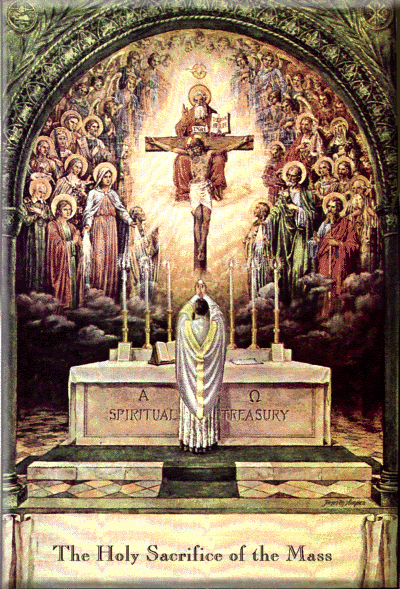
"The Mass is certainly a function the most excellent, the most holy, the most acceptable to God and useful to us, that can be imagined. And so, while it is going on, the angels assist in crowds, with bare feet, with earnest eyes, with downcast brows, with great silence, with incredible amazement and veneration. With what purity, attention, devotion, and reverence, then, ought the priest to celebrate it? He should approach the sacred altar as Jesus Christ, assist there as an angel, minister there as a Saint, offer there the prayers of the people as a high-priest, interpose there for reconciliation between God and men as a mediator, and pray for himself as a human being."--St. Lawrence Justinian
Thursday, July 26, 2007
The Merits of the Mass and How To Gain Them

Many Catholics nowadays complain that they don’t like going to Mass because they don’t get anything out of it. Either it’s boring, or annoying, or the priest has nothing new to say, or takes too long saying it, or the choir stinks, or the music sung puts them to sleep, or the incense, if any, makes them sick and the list goes on and on. Perhaps the real underlying problem for such people is that they don’t know what it is they should get out of the Mass, and not knowing that, they don’t know how to get it. To get to the bottom of this problem it may be helpful first to examine what the Mass is and what is the true purpose of religion. Religion is, to put it simply, justice towards God. Man, as a creature utterly dependent on the Almighty Creator is bound under pain of eternal damnation to worship God. The Holy Mass is the only true form of worship known to man. It alone is a sacrifice patterned after the sacrifices of the Old[1] and New[2] Testaments. The Mass is that means by which Christ has instructed us to pay homage to the Holy Trinity, not so that we find inner peace or make ourselves feel good, or enjoy an hour of liturgical entertainment every week, but so that we can render unto God what it is our bounden duty to render unto Him—that is, Worship. The Holy Mass alone is perfectly, infinitely pleasing to God, since it alone is a renewal and representation of the perfect, infinite sacrifice of Calvary, by a perfect and infinite minister, through the instrument of the priest. The priest is not the center of the Mass, and neither are the people, or the sermon or the choir. The Mass is not a self-help seminar, a concert, or a fellowship meeting. It is a sacrifice, and therefore it is worship. In the Holy Mass Christ Himself, outside of time and space, continually offers Himself as a pure oblation to the Most Holy Trinity, and we who are present at the Mass unite our offering to that of Jesus Christ to pay homage to the Most Blessed Trinity and to atone for offenses committed against God, to thank God for the innumerable benefits we have received from Him and to implore Him to supply all things that are needful to us.[3]
The merits of the Mass can be divided into two kinds, intrinsic merit and extrinsic merit. Intrinsic merit is dependent on that which is necessary for the Mass to be the Mass, that is, the substantial presence of Our Lord Jesus Christ’s Body, Blood, Soul and Divinity made present on the altar through transubstantiation by a valid consecration by a validly ordained priest. Since God is infinite, no sacrifice man can offer Him is acceptable. In the Mass, the infinite Christ, through the instrument of the priest, offers Himself as an infinite oblation and propitiatory sacrifice to the infinite Holy Trinity. Since He who offers the sacrifice is infinite and since He who is sacrificed is infinite the intrinsic merit of the Mass is infinite, and therefore the only true act of worship befitting an infinite God. Every Mass, Roman Catholic, Eastern Catholic or Orthodox has infinite intrinsic merit.
Extrinsic merit, or what we get out of it, is dependent on six principles of the Mass which are dependent on man, and through which man merits fruits and graces from the Mass. Since man in finite, the fruits he merits from the Mass are finite. The extrinsic merit of a Mass is finite and may increase or decrease according to the degree to which God is glorified through the six extrinsic principles of the Mass.[4] Simply put, the greater glory given to the Holy Trinity through the extrinsic parts of the Mass, the more meritorious is that particular Mass. That which is most pleasing to God is most meritorious to man.[5] That Mass which possesses to the greatest degree the six extrinsic factors of the Mass is most pleasing to God and most meritorious to man. For our purposes we will consider each principle independent of the others.
The first principle by which God is pleased with the Mass and by which man merits extrinsic fruits from the Mass is the Church Herself. Since the Holy Sacrifice of the Mass is an act of the Church, offered always as a public prayer, then the merit of the Mass is founded upon the holiness of the Church.[6] The Church, the Mystical Body of Christ, especially the reigning Pope, the bishops, and the clergy throughout the world, can increase and decrease in holiness as her members increase and decrease in holiness.[7] That Mass which is offered in communion with the Church is more meritorious than that Mass offered outside the church. So the mass of the Greek Orthodox is less pleasing to God regarding the first principle than the Masses of the Eastern Catholics or Roman Catholics, even though the Greek Orthodox Mass may possess to a greater degree one of all of the other five factors of extrinsic merit. In fact, since the right to administer the sacraments, offer the Mass, or employ any other element of sanctification, has been given to the Catholic Church alone, it is always displeasing to God whenever they occur outside the Church, for the rights of the Church given to Her by Christ, and therefore justice, are violated. This includes not only the Mass, but baptisms, marriages, confirmations, holy orders, communion, and all the sacraments that our schismatic brethren administer.[8]
The second principle by which men merits extrinsic fruits from the Mass is through the office of the priest, be he Pope, Bishop, or parish Priest.[9] The Mass offered by the Pope, having the fullness of the priesthood, has a greater potential to merit fruits than the Mass offered by a simple parish priest by virtue of the fact that the Pope exercises a higher office than the priest.[10] Likewise, the Mass offered by a Bishop has a greater potential for merit than the Mass of a simple priest, and less potential for merit than the Mass of the Pope.
The third principle by which man merits extrinsic fruits from the Mass is through the person of the priest. The more holy the priest, the more he is able to merit for himself and for those for whom he offers Mass. The less holy he is the less he is able to merit. This is confirmed in the writings of St. Bonaventure: “All Masses are equally good, as far as Christ is concerned; but as far as the priest is concerned, one may be better than another. Therefore it is more profitable to hear the Mass of a good priest than of an indifferent one.” Also Cardinal Bona corroborates: “The more holy and pleasing to God a priest is, the more acceptable are his prayers and oblations; and the greater his devotion, the greater the benefit derived from the Mass. For just as other good works performed by a pious man gain merit in proportion to the zeal and devotion with which they are performed, so Holy Mass is more or less profitable both to the priest who says it and the the persons for whom it is said, according as it is celebrated with more or less fervor.”[11]
The fourth principle by which man merits extrinsic fruits from the Mass is through the faithful present at the particular Mass. The more holy are those who assist at Mass by their prayers, the greater the merits of that particular Mass. Furthermore, the more reverently they offer the Mass the greater the merits of that Mass.[12] The opposite is also true. The less holy are those assisting at Mass, the lesser the merits of that particular Mass. The value of the extrinsic merits of the Mass is so affected by those who offer the sacrifice and those who assist by their prayers that should even one of them receive the sacred species in a state of mortal sin, they detract from the over-all extrinsic merits of the Mass, because they dishonor the Most Holy Trinity with their sacrilege and detract from the Glory and Adoration that is Its due. Since only those in a state of grace can merit,[13] those who assist at Mass who are in a state of mortal sin are “dead weight,” so to speak, although the grace of conversion can be merited for them, if they are so disposed, by those at the Mass who are in a state of grace.[14]
The fifth principle by which man merits extrinsic fruits from the Mass is through the decora, or the aesthetics of the Mass. This may at first seem to be a subjective factor and therefore have no place in an assessment of the transcendent sacrifice of the Catholic Mass, but a closer look at what a true aesthetic sense is, especially in relation to God, will show this factor to be very objective after all.
An aesthetic sense is the ability to grasp what is truly beautiful. A thing can have more or less beauty if the attributes of beauty are possessed more or less. God is pleased with those things that are truly beautiful, therefore He is pleased more or less according to the degree a thing is beautiful. True beauty consists of three attributes: clarity, symmetry or proportion, and perfection or completion.[15] And beauty is relevant to the thing as it is. God, being omniscient, knows the thing as it is, and therefore is more pleased by true beauty than by a lack of it. With regard to the Mass these three attributes are best manifested in the fittingness of a particular thing in relation to the sublime sacrifice in which it is used, and the degree of sacrifice that was involved to procure the thing. Take for example the sacred vessels. They are called sacred for they contain within them the most sacred Body and Blood of Our Lord and Savior Jesus Christ. It is more fitting that these vessels should be made of the most precious materials man can offer as they contain the most precious victim God has given man to offer back to Him. The same is true of the tabernacle, in which central location on the altar we find that clarity which teaches that God is He Who we have come to worship, and that Christ is that sacrifice that will be offered up to Him as well as the minister of that sacrifice.
Let us examine the last two extrinsic parts of the Mass, the decora and the Mass itself, in relation to these three attributes. That rite of Mass possesses superior clarity, which manifests Catholic dogma more clearly both in its prayers and its liturgical gestures. The same can be said for the decora. Sacred vessels made of precious metals are more fitting to the sacred species, which is the most precious sacrifice man can offer to God.
When examining the decora this should be the defining question: “What is most fitting of worship of the almighty God in the Most Blessed Trinity, Who is most pleased by those things that are truly beautiful?” Under the category of decora falls the vestments, the music, the architecture, the statues and sacred images, the altar and tabernacle, the incense, the bells, the candles, the vessels, the arrangement and outfitting of the sanctuary, the altar linens, the patens, the acolytes, the attire of the faithful, and the list goes on. Not only are these things measured for their beauty, but for the selflessness, or sacrifice, with which they were given. We are all familiar with the parable of the widow’s mite. Those items which required the greater sacrifice to obtain, or to donate, are more meritorious than those items, though more rare, exquisite, ornate, or expensive, which did not require as great a sacrifice. (Consider for just a moment the tremendous sacrifice made on the part of all the saints and martyrs throughout more than a thousand years in the celebration, development and preservation of the Traditional Roman Rite of the Mass.)
The second attribute of beauty is symmetry or proportion. That Mass possesses superior symmetry in which what occurs exteriorly is proportional to what is occurring interiorly. When we are interiorly worshipping the almighty and infinite God we should be humbling ourselves. When this is reflected in our posture, for example, by kneeling humbly, our exterior is in exact proportion to our interior, and we thereby give greater glory to God with this symmetry, which makes the Mass more beautiful. Since God is the object of our worship, then that Mass is more beautiful for its symmetry when God, reserved in the tabernacle, is the focus of our attention, i.e. at the center of the altar, the priest and people facing Him rather than each other. Since the Mass is truly a sacrifice the particular Mass that is most pleasing to God is one in which our exterior actions reflect our interior disposition. Father Martin von Cochem sums it up thus, “Hence we see clearly that we can do as much to please Our Lord, and acquire as much merit for ourselves when we hear Mass as we should have done had we been present on Calvary, if we are no less devout and recollected than we should been standing beneath the Cross.”[16]
The last attribute of beauty, perfection or completion, is found in rendering unto God all that is due to Him in the way in which it is due to Him. That Mass is perfect, or complete, in which is present the miraculous, the supernatural and the sacred which is proper to the sacred liturgy, that prayer which is addressed to God, the font of all that is holy and sacred. The perfection of the Mass can be found primarily in the particular prayers and rituals of the rite. Among the many rites of the Mass there are the Eastern Rite, the Orthodox Rite, the Ancient, Traditional or so-called Tridentine Rite, and the Novus Ordo, or New Order. Of these four only the Orthodox Rite is not celebrated in full communion with Rome and therefore lacks the extrinsic merits derived through the Church, Herself. Nevertheless, that rite of Mass which possesses all three of the attributes of beauty to a greater degree than any other is more pleasing to God as regards decora and therefore more meritorious to man on that count.
There are no less than 77 graces and fruits that may be derived from the Mass to man’s benefit.[17] That Mass in which the extrinsic parts of the Mass give greater glory to God, is more meritorious to those who offer that Mass and to those for whom it is offered, than that Mass which possesses to a lesser degree the six principles of extrinsic merit. The intrinsic value of the Mass is always infinite, because the Mass is an infinite God offering an infinite sacrifice, to an infinite Trinity. However, the extrinsic value of the Mass, derived from those parts which we as finite human beings bring to the Mass, is determined by the sanctity with which we offer them, and the glory given to God through them. These parts which we must strive to increase, in holiness, sacredness, reverence, humility, so that we may increase the fruits and graces we may derive from the Mass for ourselves and for the whole world.
In the Holy Mass the fruits of Christ’s Passion and Death are more bounteously applied to our souls than by any other means. The merits of Christ’s sacrifice at Calvary are infinite, won at once, for all who are worthy to partake of them.[18] Baptism gives each of us the means by which we may partake of Christ’s merits. It is as if in baptism we are given a tiny silver baby spoon to dip from the infinite fountain of God’s mercy. Each time we worthily receive the sacraments, in particular Confession and Holy Communion, each time we do supernaturally good works, or make sacrifices, or mortify our senses, or pray earnestly we exchange our spoon for a larger one and each one is filled with God’s grace. When we commit venial sins we compromise the integrity of our spoons, ladles, dippers, buckets, the containers with which we partake of the fountain of Christ’s merits. After so many sins our containers may be shattered by mortal sin. Confession obtains for us a new container, of the same capacity as the one broken by our wickedness. Nothing on earth can increase the capacity for grace of our containers so tremendously as that of Holy Mass. And the capacity of our containers is increased in the Mass through all six of the factors we have discussed. So when speaking of the merits of the mass, we are referring to the increase in the capacity of our containers, which are filled to the full from the infinite fountain of the merits of Christ’s Passion. When we speak of the infinitude of the Mass we are also referring to the glory and adoration we give to God thereby. Since our sins are infinitely offensive to God, the only means whereby we can make adequate reparation To Him is through the infinite sacrifice of the Mass. Justice between man and God is not possible as we understand justice between men. Justice must exist between equals. But God is infinite and man is so unequal to Him as to be utterly incapable of offering Him anything fitting of his own accord. Therefore, in justice man is bound to offer to God all that God has given man the power to offer Him. When, through the sacrifice of Christ in the Mass, man offers to God all God has given him to offer back to Him, that is the blood, the tears, the wounds, the death, and the merits of Christ, and all the virtue, love, reverence, piety, humility, obedience, faith, hope, devotion, passion, etc. that each man has within himself, God returns to man no less than double what man offers.[19] This is the economy of grace through which God draws us closer to Him. Our Lord, who will not be outdone in generosity, said to St. Mechtilde, “Behold, I give thee My charity, My prayers, My bitter sufferings; I make them thine that thou mayst give them back to Me. To each one who does this, I return his gift twofold measure; and as often as it is presented to Me, I will restore it thus increased. This is the hundredfold which was promised to men in this world and eternal life hereafter.”[20]
Oh, if only man invested his spiritual resources as shrewdly as he does his material ones. What riches he would store up for himself in Heaven! Devote yourself to the Holy Mass, and never let an opportunity to offer it to God pass you by without good reason, for it is most assuredly the best and the most beautiful, the most pleasant, and the least painful way to atone for your sins and those of the whole world and obtain to that eternal reward which is the union with God, Himself.
[1] Gen 14:18, Melchesidek, king of Salem, brought out bread and wine; he was priest of God Most High. Ex. 24:6-8, 6: And Moses took half of the blood and put it in basins, and half of the blood he threw against the altar. 7: Then he took the book of the covenant, and read it in the hearing of the people; and they said, “All that the LORD has spoken we will do, and we will be obedient.” 8: And Moses took the blood and threw it upon the people, and said, “Behold the blood of the covenant which the LORD has made with you in accordance with all these words. Mal 1:11, For from the rising of the sun to its setting my name is great among the nations, and in every place incense is offered to my name, and a pure offering; for my name is great among the nations, says the LORD of hosts.
[2] Hebrews 5 1-6, For every high priest chosen from among men is appointed to act on behalf of men in relation to God, to offer gifts and sacrifices for sins. He can deal gently with the ignorant and wayward, since he himself is beset with weakness. Because of this he is bound to offer sacrifice for his own sins as well as for those of the people. And one does not take the honor upon himself, but he is called by God, just as Aaron was.
[3] The New St. Joseph Baltimore Catechism, Q. 361, “What are the purposes for which the Mass is offered? The purposes for which the mass is offered are: first, to adore God as our Creator and Lord; second, to thank God for His many favors; third, to ask God to bestow His blessings on all men; fourth, to satisfy the justice of God for the sins committed against Him. These purposes are realized in every Mass regardless of the dispositions of the priest or people. In addition, there flow from each Mass special fruits, or blessings, upon the celebrant, servers, those present, those for whom it is offered, and all mankind, especially all members of the Church and the souls in purgatory. These blessings may be increased or decreased by the good or bad dispositions of each person concerned.”
[4] The New St. Joseph Baltimore Catechism, Q. 361, “…In addition, there flow from each Mass special fruits, or blessings, upon the celebrant, servers, those present, those for whom it is offered, and all mankind, especially all members of the Church and the souls in purgatory. These blessings may be increased or decreased by the good or bad dispositions of each person concerned.”
[5] James 5:16, Therefore confess your sins to one another and pray for one another that you may be healed. The prayer of the righteous man has great power in its effects.
[6] Gihr, The Holy Sacrifice of the Mass, Book One, Chapter the Third, Article the Second, p. 143, “At the altar the united Church offers and prays through the priest, her representative and delegate; there she presents to God the Sacrifice of praise and thanksgiving, of propitiation and petition. Under this aspect, the value and efficacy of the Sacrifice of the Mass is measured by the dignity, merit and sanctity of the Church. From this it follows that the value of the Eucharistic Sacrifice, inasmuch as the Church offers it, is always finite and limited, for at no time has she been nor can she be infinitely holy. It is self-evident that on the part of the Church the effects which follow the celebration of Mass are always limited as to degree and greatness. It must here be noted, however, that the Church, inasmuch as she offers the Holy Sacrifice and prays through the priest, cannot merit and satisfy, since for this is required a positive action of suffering of a person pleasing to God. But in the celebration of Mass, there is, on the part of the Church, no such positive activity, to which could be attached the power of meriting or satisfying. Accordingly, the celebration of the Eucharistic Sacrifice by the Church has only impetratory power, that is, she can draw down graces and blessings from Heaven only by way of petition.”
[7] Gihr, The Holy Sacrifice of the Mass, Book one, Chapter the Third Article the Second, p. 144, “But since the holiness of the church consists in the sanctity of her members, it is not always and invariably the same, but greater at one period than at another; therefore, the Sacrifice of the Church is also at one time in a greater, at another in a less degree pleasing to God and beneficial to man.”
[8] Catholic Encyclopedia, vol. 10, p. 18
[9] Summa Theologica III, Q. 82, a. 6, “It is stated in Decretal I, q. 1: ‘The worthier the priest, the sooner is he heard in the needs for which he prays.’ I answer that, There are two things to be considered in the mass, namely, the sacrament itself, which is the chief thing; and the prayers which are offered up in the Mass for the quick and the dead. So far as the mass itself is concerned, the Mass of a wicked priest is not of less value than that of a good priest, because the same sacrifice is offered by both. Again, the prayer put up in the Mass can be considered in two respects: first of all, in so far as it has its efficacy from the devotion of the priest interceding, and in this respect there is no doubt but that the Mass of the better priest is the more fruitful. In another respect, inasmuch as the prayer is said by the priest in the Mass in the place of the entire church, of which the priest is the minister; and this ministry remains even in sinful men, as was said above (5) in regard to Christ’s ministry. Hence, in this respect the prayer even of the sinful priest is fruitful, not only that which he utters in the mass, but likewise all those he recites in the ecclesiastical offices, wherein he takes the place of the Church. On the other hand, his private prayers are not fruitful, according to Prov. 28:9 ‘He that turnest away his ears from hearing the law, his prayer shall be an abomination.’”
[10] Second Vatical Council, Christum Dominus, para. 15, “Bishops enjoy the fullness of the sacrament of orders and both presbyters and deacons are dependent upon them in the exercise of their authority.”
[13] Ott, Fundamentals of Catholic Dogma, p. 415, “As the Sacrifice of the Mass does not work mechanically any more than the Sacraments, the receiving of the fruits of the Sacrifice demands certain due moral dispositions, and the measure of the fruits is dependent on the quality of these dispositions (cf. D 799).”
[14] Von Cochem, The Incredible Catholic Mass, p. 316, “But in order to hear mass, one need not be in a state of grace, for as we have already shown, if aman hears Mass in a state of mortal sin, he does not commit another sin; on the contrary, he receives the grace of conversion if he open his heart to divine influences. In fact, he is not wrong in hoping that, in virtue of the Precious Victim that is offered, God will, of His pure bounty, show him mercy.”
[15] Summa Theologica I, Q. 36, a. 8, “For beauty includes three conditions, ‘integrity’ or ‘perfection,’ since those things which are impaired are by the very fact ugly; due ‘proportion’ or ‘harmony’; and lastly, ‘brightness’ or ‘clarity,’ whence things are called beautiful which have a bright color. The first of these has a likeness to the property of the Son, inasmuch as He as Son has in Himself truly and perfectly the nature of the Father. To insinuate this, Augustine says in his explanation (De Trin. Vi, 10): ‘Where—that is, in the Son—there is supreme and primal life.’ etc. The second agrees with the Son’s property, inasmuch as He is the express Image of the Father. Hence we see that an image is said to be beautiful, if it perfectly represents even an ugly thing. This is indicated by Augustine when he says (De Trin. Vi, 10), ‘Where there exists wondrous proportion and primal equality,’ etc. The third agrees with the property of the Son, as the Word, which is the light and splendor of the intellect, as Damascene says (De Fide Orth. Iii, 3). Augustine alludes to the same when he says (De Trin. Vi, 10): ‘As the perfect Word, not wanting in anything, and, so to speak, the art of the omnipotent God,’ etc.”
[16] Von Cochem, The Incredible Catholic Mass, p. 145
[17] Von Cochem, The Incredible Catholic Mass, pp. :
“1. For thy salvation God the Father sends his beloved Son down from heaven.
2. For thy salvation the Holy Spirit changes bread and wine into the true Body and Blood of Christ.
3. For thy sake the Son of God comes down from heaven and conceals Himself under the form of the sacred host.
4. He even abases Himself to such an extent as to be present in the minutest particle of the Sacred Host.
5. For thy salvation He renews the saving mystery of the Incarnation.
6. For thy salvation He is born anew into the world in a mystic manner whenever Holy Mass is celebrated.
7. For thy salvation he performs on the altar the same act of worship He performed when on earth.
8. For thy salvation He renews His bitter passion in order that thou mayest participate in it.
9. For thy salvation He mystically renews His death, and sacrifices for Thee His precious life.
10. For thy salvation He sheds His blood in a mystic manner, and offers it up for thee to the Divine Majesty.
11. With this Precious Blood He sprinkles thy soul and purifies it from every stain.
12. For thee Christ offers Himself as a true burnt-offering, and renders to the Godhead the supreme honor which it is due.
13. By offering this act of worship to God, thou dost make reparation for the glory which thou hast failed to give Him.
14. For thee Christ offers Himself to God as a sacrifice of praise, thus atoning for thy omissions in praising His Holy Name.
15. By offering to God this oblation which Christ offers, thou givest Him greater praise than do the Holy Angels.
16. For thee Christ offers Himself as a perfect sacrifice of thanksgiving, making compensation for all failures on thy part to render thanks.
17. By offering to God Christ's act of thanksgiving, thou dost make ample acknowledgment of all the benefits He had bestowed on thee.
18. For thee Christ offers Himself as the all powerful victim, reconciling thee to the God Whom thou hast offended.
19. He pardons thee for all thy venial sins, provided thou art firmly resolved to forsake them.
20. He also makes repartition for many of thy sins of omission, when thou didst leave undone the good thou mightest have done.
21. He removes many of the imperfections attaching to thy good deeds.
22. He forgives thee the sins, unknown or forgotten, which thou hast never mentioned in confession.
23. He offers Himself as a victim to make satisfaction for a part at least of thy debts and transgressions.
24. Each time thou hearest Mass thou canst do more to pay the penalty due to thy sins than by the severest work of penance.
25. Christ places to thy credit a portion of His merits, which thou mayest offer to God the Father in expiation of thy offences.
26. For thee Christ offers Himself as the most efficacious peace-offering, interceding for thee as earnestly as He interceded for His enemies on the cross.
27. His Precious Blood pleads for thee in words as countless as the drops which issued from His sacred veins.
28. Each of the adorable wounds His sacred body bore is a voice calling aloud for mercy for thee.
29. For the sake of this propitiatory victim, the petitions proffered during Mass will be granted far sooner than those that are proffered at other times.
30. Never canst thou pray so well as whilst present at Mass.
31. This is so because Christ unites His prayers to thine, and offers them to His heavenly Father.
32. He acquaints Him with thy needs and dangers to which thou art exposed, and makes thy eternal salvation His particular concern.
33. The angels also, who are present, plead for thee, and present thy poor prayers before the throne of God.
34. On thy behalf the priest says Mass, by virtue of which the evil enemy will not be suffered to approach thee.
35. For thee and for thy everlasting salvation he says Mass, and offers that holy sacrifice to God Almighty.
36. When thou hearest Mass, thou art thyself in spirit a priest, enpowered by Christ to offer the Mass both for thyself and others.
37. By offering this Holy Sacrifice, thou dost present to the Blessed Trinity the most acceptable of all oblations.
38. Thou dost offer an oblation precious indeed, of greater value than all things in heaven and earth.
39. Thou dost offer an oblation precious indeed, for it is none other than God himself.
40. By this sacrifice thou does honor God as He alone is worthy to be honored.
41. By this sacrifice thou dost give infinite satisfaction to the Most Holy Trinity.
42. Thou mayest present this glorious oblation as thine own gift, for Christ Himself gave it unto thee.
43. When thou hearest Mass aright, thou dost perform an act of highest worship.
44. By hearing Mass thou dost pay the most profound reverence, the most loyal homage, to the Sacred Humanity of Our Lord.
45. It is best means whereby to venerate the Passion of Christ, and obtain a share in its fruits.
46. It is also the best means of venerating the blessed Mother of God, and increasing her joy.
47. By hearing Mass, thou canst also enrich thy soul more than aught else in the world.
48. By hearing Mass devoutly, thou canst give greater honor to the angels and the saints than by reciting many prayers.
49. For this in act thou dost perform a good work of the highest value.
50. It is a signal exercise of pure faith, which will receive a great reward.
51. When thou dost bow down before the Sacred Host and the Sacred Chalice, thou doest perform a supreme act of adoration.
52. For each time thou doest gaze reverently upon the Sacred Host thou wilt receive a recompense in heaven.
53. Each time thou dost smite thy breast with compunction, some of thy sins are remitted to thee.
54. If thou hearest Mass in a state of mortal sin, God offers thee grace of conversion.
55. If thou hearest Mass in a state of grace, God gives augmentation of grace.
56. In Holy Mass thou doest spiritually eat the flesh of Christ, and drink His blood.
57. Thou art privileged to behold with thine eyes Christ hidden under the sacramental veil, and to be beheld by Him.
58. Thou dost receive the priest's benediction, which is confirmed by Christ in heaven.
59. Through thy diligence in hearing Mass, thou wilt also obtain corporal and temporal blessings.
60. Furthermore, thou wilt be preserved from many misfortunes that would otherwise have vanquished thee.
61. Thou wilt also be strengthened against temptations which would have otherwise have vanquished thee.
62. Holy Mass will also be to thee a means of obtaining grace of a holy death.
63. The love thou hast shown for Holy Mass wilt secure for thee the special succor of angels and saints in thy last moments.
64. The remembrance of the Masses heard in thy lifetime will be a sweet solace to thee in the hour of death, and inspire thee with confidence in the divine mercy.
65. They will not be forgotten when thou dost stand before the strict Judge and will incline Him to show thee favor.
66.Thou needest not a fear a long and terrible Purgatory if thou hast already to a great extent atoned for thy sins by frequently assisting at Holy Mass.
67. One Mass devoutly heard will do more to mitigate the pains of Purgatory than any act of penance, however difficult of performance.
68. One Mass in thy lifetime will be of greater service to thee than many said for thee after death.
69. Thou wilt attain a high place in heaven, which will be thine to all eternity.
70. Thy felicity in heaven will, moreover be increased by every Mass thou hearest on earth.
71. No prayers offered for thy friends will be as efficacious as a single Mass heard and offered on their behalf.
72. Thou canst amply recompense all thy benefactors by hearing Mass for their intention.
73. The best help, the greatest consolation, thou canst afford the afflicted, the sick, the dying is to hear Mass for them.
74. By this same means thou canst even obtain for sinners the grace of conversion.
75. Thou canst also earn for all faithful Christians saving and salutary graces.
76. For the suffering souls in Purgatory thou canst procure abundant refreshment.
77. And if it is not within thy power to have Mass said for thy departed friends, thou canst by devout assistance at the Holy Sacrifice release them from the tormenting flames.
What dost now think of the Holy Mass, O Christian? Can it be supposed that in the whole world there is any other good work whereby so many graces and fruits are placed within our reach? It is no longer possible to question the truth of the words of Father Sanchez: "If Christians only knew how to profit by Holy Mass, they might acquire greater riches than are to be found in all things God has created." We have indeed a precious storehouse in the Mass: happy he who can earn treasures so great at the cost of so little labor! Who would willingly miss Mass?
Who would not delight in hearing it? Let us resolve never to lose an opportunity of hearing Mass, provided the duties of our state of life do not prevent us from doing so.
To omit hearing Mass merely from carelessness or indolence would be proof that we were either ignorant of, or indifferent to, the divine treasures it contains. God grant that those who read this may in future appreciate more fully this pearl of great price, value it more highly, seek it more diligently. Ponder this.”
[18] Von Cochem, The Incredible Catholic Mass, p. 317, “Most assuredly, all our hope is in Christ’s Passion and death, profided the fruits and merits of His sufferings are applied to our sould; if not, it is in vain that we trust in them. What does it profit the reprobate sinner that Christ suffered and died for him, if in spite of this he is damned? And why is he damned: Because the merits of Christ’s Passion have not been applied to him, and the reason why they have not been applied to him is that he was not worthy of it. How then can we make ourselves worthy? By true compunction, by a right reception of the Holy Sacraments, by good works, but above all, by piously saying or hearing Mass. For Holy Church bids us know that ‘the fruits indeed of that Bloddy Oblation, the sacrifice of the Cross, are received most plentifully through that unbloody one, the Sacrifice of the Mass.’ (Council of Trent, Sess. Xxii, Ch. 2).”
[19] Von Cochem, The Incredible Catholic Mass, p. 316, (Lest the lukewarm despair I thought it important to include the following note), “And he who, not being in a state of mortal sin, hears Mass, though with no great fervor, not only commits no sin, but is warranted in trusting confidently that, through the sacrifice of the Body and Blood of Christ, he will obtain an increase of grace and remission of a part of the penalty due to his sins.”
[20] Von Cochem, The Incredible Catholic Mass, p. 367.
Subscribe to:
Posts (Atom)