Part of the mystique of homeschooling is how very different it is from the mainstream. For most homeschoolers it is not only a different way of educating our young, but a different way of life entirely. This difference is a definite turn-off to some folks, but a strong lure for others. For Catholics it is a necessity. I'm still reading Kay Toy Fenner's book, American Catholic Etiquette, and she summed up very nicely what I want to say on this matter:
"Many influences in modern living unite to induce the general public to accept a universal standard of morals, behavior, opinion, manners and dress. To some extent this has always been so; our ideas in these areas have ever been heavily influenced by those of our fellows. Universal literacy, the availability of inexpensive books and magazines, and our public school system have encouraged the spread of common standards. To these we add today television, radio, and moving pictures, and, most important of all, the development of certain psychological theories as to how man can best function in a modern world.
"...The educators engaged in teaching children how to 'function in the group,' to accept the 'will of the majority' as the standard of what constitutes right behavior, are, from their own point of view, merely assisting children to live happily with their fellows. All of this would be intensely valuable, if the ideas and standards upheld were the noblest possible. Unfortunately, setting such a universal uniform standard always means levelling down. One can never level 'up.' The standards acceptable to humanity at large will always be inferior to those possible to the brightest and the best. If these inferior standards are held up to the superior members of a society as ideal, such members are robbed of all incentive to struggle to the heights which may be possible to them.
"This results in an incalculable loss to mankind. Our great philosophers, saints, radicals, inventors--those whom A.W.E. O'Shaughnessy called 'the movers and shakers of the world'--have always been 'different' from the common run of man, and have been rightfully proud of their differences. Such people are the yeast which leavens the loaf of mankind; if they fail to rise, the loaf will become a pancake.
"For society at large, the acceptance of a low dead level of conformity, the spread of a common fear to differ from one's fellows, is a tragedy. For Catholics, it is impossible. We are, and will continue to be (for how long only God knows, but He knoweth) a minority group. Socially and governmentally, this is unimportant. In the realm of ideas and moral standards, it is important, and it is just in these realms that we are far more of a minority than we were a hundred years ago...
"This means that present-day Catholics must learn and must teach their children to differ from the majority of their fellows in many basic moral principles, to love and cherish those with whom they differ, while refusing to accept, as their moral guides, standards with which they do not agree. To do this, neither doubting one's own position nor rejecting all who differ from it, one must constantly bear in mind that the number of persons who hold any set of opinions has nothing to do with the rightness of one's position; to differ, and to be in the minority while differing, has no bearing on whether one is right or wrong.
"Granting that it is valuable to dare to be different, how does one go about teaching one's children independence of thought and action? One first examines one's own attitudes and opinions to see whether they are based on independent conclusions, or unconscious acceptance of what one sees and hears..."
In my mind there is a very simple answer to her question that goes beyond examining one's own opinions. I believe that the answer is to look to Tradition, and traditions--of morals, behavior, opinion, manners and dress. And not just the traditions of the first 69 years of the 20th century, but the Tradition of 2,000 years of Catholic saints and scholars, and ordinary folks like us, who, by Christ's example have been held to the highest standards. I've always hated the terms "liberal" and "conservative" because they are comparative terms that use eachother to guage themselves, rather than a transcendent reality. And one can be as liberal as liberals were 50 years ago, but still be considered conservative only because the liberals are more liberal than they were 50 years ago. The only comparison for a Catholic is Christ, and His Blessed Mother. "What would Jesus do?" as cliche as it is, is the only question we need ask ourselves. "Would Mary wear these tight jeans?" or ..."use this kind of language, or watch this movie or read this book?" Catholics, because we follow He Who set the highest standard, are bound to aspire to the highest standard. We must strive to practice the "best" manners, the "best" behavior, hold the "most" virtuous opinions, dress the "most" modestly, and hold ourselves to the "highest" moral code. We cannot allow ourselves or our children to "level down" to what is most prevalent, mediocre, or common. We are followers of Him who was unlike anyone who ever walked the face of the Earth. We must emulate His example, and in so doing will be more like Him, and less like those, interiorly as well as exteriorly, who are not His followers. We may find others who are like us, but let it be because they too strive for the highest standards, and not because we have become lukewarm and settled for mediocrity.
Mrs. Fenner continues:
"Those who have had the advantage of being gently reared or have had more educational opportunities will have higher standards than those who have not. Children who are taught from infancy about morals and ethics will try harder to be good than those who never hear the subject mentioned. Explain that you are trying to teach them what you consider to be the very best behavior: the most honorable, the most courteous, the kindest. Admit that there may be people with higher standards than yours, and many with standards that are lower. But your standards are the ones that you are convinced are best for you and your family. You therefore expect your children to learn to live up to them, even though in so doing their lives will often differ in many ways from those of their friends. They should consider themselves fortunate that they have parents so devoted and so idealistic, and they will so consider themselves when they are older and know enough to evaluate such matters. They should never be afraid to differ from their comrades in doing that which they know, from their home training, is right.
"Caution your children, also, not to criticize the behavior of others. Explain that those fortunate enough to be taught at home to strive for the highest standards have an obligation to be kind and forebearing to those who have not had such advantages. If you are convinced of the truth of all this, your children will sense the weight of your conviction and will abide by your opinions."
She concludes by reminding parents that it is alright for children to be like others on morally neutral matters, but on matters of morals, modesty, and manners, they cannot strive for any less than the highest standards.
I found these insights, written in the 60's, to be very helpful and just as relevant today as they were 45 years ago, if not more so. I hope you find them as helpful as I did! In Sanguine Christi,
Friday, August 24, 2007
A Dead Thing Flows With The Current--Only A Living Thing Can Swim Against It


Tuesday, August 14, 2007
To Shield or Not To Shield
I've been contemplating the matter of sheltering, or shielding our children (especially after a Catholic, homeschooling friend of mine asserted a few weeks ago that she did not want her children to be sheltered and wanted them to associate with other kids who have not been sheltered--whatever that means), and have been collecting various morsels on the matter from my spiritual reading, other friends, priests, and of course, my mother, which I will post after I've wrapped my mind around them and they take shape.
For today, however, I found the reading from my Imitation of Mary to be quite relevant, and a good start to any thorough examination of the matter. But first, a preface:
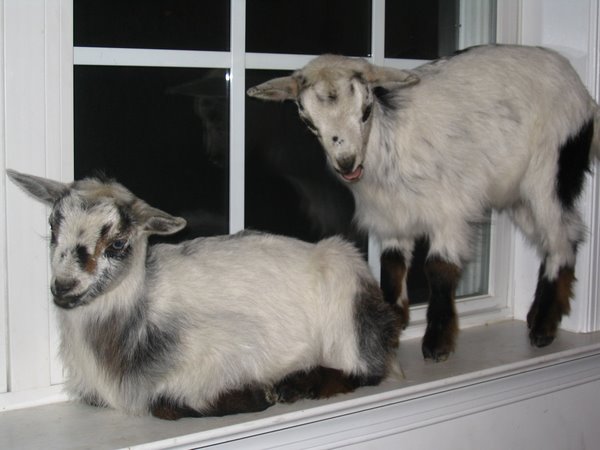
There is a funny trend among some folks nowadays of accusing certain parents of sheltering their children, as though it were a bad thing. I find it rather odd, as I’m sure the same folks would not look favorably on the alternatives. Why, if I were to cast my children out of our rather comfortable home to live in the barnyard with the goats, year round, what would they think of me then? If I were to carelessly expose them to every sort of disease and bodily peril I would surely be dragged into court by child protective services for reckless endangerment and most likely loose custody of my children all together. Suppose I were to feed them only what we would otherwise throw into the compost bin? Or make them to clothe themselves in whatever they may scrounge up from the woods? It is a funny thing indeed for some folks to accuse certain parents of sheltering their children when these same folks would never do without shelter themselves.
Of course, living in a material world we place much more importance on the material, which includes, of course, our bodies and those material things we shelter them with. But Catholic parents are keenly aware of the existence of the soul in the spiritual world, which includes Heaven and Hell, which endures for eternity. This is why I am utterly baffled when I hear good Catholic parents proclaim that they do not want their children to be sheltered. Of course, I know they are not referring to their children’s bodily sheltering, but to the sheltering of their spirits, their minds and hearts and souls, from the onslaught of a Godless world. How do they expect to make a strong case for themselves when they stand before the Heavenly court, whose justice is perfect and will be neither deceived nor persuaded by even the most brilliant rhetorician?
Perhaps it would be best to back up for a moment and explore what it means to shelter or not to shelter a child. I have long revered the analogy of a child to a plant, which, when set in a good environment, exposed to what is good for it’s growth: ample, but not too much sunlight; nutritious but not too rich soil; sufficient, but not excessive uncontaminated water; pruned each year a little but not too much; and shielded from what is harmful to it’s growth—harsh winds, cold, insects that feed on its leaves, flowers and fruits, etc. will grow to it’s full potential, strong and beautiful, able to withstand the elements that in it’s youth threatened it’s very existence. A certain amount of sheltering is necessary for the survival of every living thing.
Shielding, or sheltering our children, in my mind is no more than protecting their virtue. In the Imitation of Mary we read:
“Mary was conceived in God’s grace; there was no trace of sin in her nor any inclination to sin. Therefore, unlike us, she had no reason to hear falling into sin. Yet, if you were to judge by the way she acted, you would say that she had as much reason to fear it as we do, or even more than we do?
“She watched constantly over her own heart as though creatures could have drawn her affections to themselves. She watched over her every word as though she could not trust her tongue.
“In her conception she was given all the privileges that go with sinlessness, yet she decided to live permanently as a penitent?
“We, on the contrary, are surrounded by flattering, treacherous enemies whose sole aim is to use our natural weakness to bring about our fall. Yet we have no fear and are not watchful at all!
“We admit that we are weakness incarnate, yet frequently we expose ourselves to temptations that would bring down even the strongest soul.
“When weakness is compounded by presumption, does it not deserve to lose all that supports it and gives it strength?
“We carry the treasure of grace in a very weak vessel (2 Cor. 4, 7), that can shatter when we least expect it.
“How many enemies are trying to snatch this treasure from us? Enemies within, enemies outside, enemies all around us.
“Within us, there are the passions we have not sufficiently mastered; outside, the spirit of darkness; around us, a corrupt world. Like a flame not fully extinguished, our passions can always be rekindled and light a fire.
“Even if we were, like St. Paul, snatched up to the third heaven (2 Cor. 12, 3), we would still have to fear being cast down with the rebellious angels into the bottomless abyss.
“It is not enough to assure ourselves that our sentiments are heartfelt and our resolution fervent.
“A single inopportune occasion is enough to destroy us.”
Perhaps the real problem lies in all the current blather about universal salvation, and the eclipse of the traditional teaching that if one dies with even one mortal sin on his soul he WILL suffer eternal fire.
Happy parenting!


Sunday, August 12, 2007
Shielding Children
Why Johnny Quit Church
This is an excellent article on shielding our kids from bad influences, and why, if we don't, even if we do all the positive things to keep our kids Catholic (Mass, Rosary, Scapular, etc.), they could still go astray and even lose their faith. It's not easy raising kids Catholic these days and it seems parents need to play it safe. Our children's souls are too precious to take chances with.

Thursday, April 5, 2007
The Dangers of Internet Chatrooms
Practically every conscious American, as opposed to the unconscious ones that my sister speaks of in her speech, are aware of the fact that internet chat rooms and blogospheres are feeding grounds for child predators, swindlers, thieves and every other form of lecherous sadist the human race can offer. Only the most completely and utterly brain dead Americans will argue that these venues are not among the leading threats to national security, consuming hundreds of thousands of dollars and man hours in screening, sifting and tracking down worldwide potential terrorists and traitors. And the popular World War II axiom, “Loose lips sink ships,” could easily be updated to “Frenzied finger tips sink ships.”
For the sake of my argument, however, let’s stick to the chat rooms and blogospheres of Patriotic Catholic Americans.
What danger could there be among such a virtuous test group, you ask. Why, to the Catholicism and Patriotism of said Americans, of course!
Keep this thought in mind: Catholicism as well as Patriotism is grounded in fraternal charity.
First of all, because of the addictive nature of the Internet, one could easily spend 10-12 hours a day chatting, while neglecting one’s familial and neighborly responsibilities as well as one’s own spiritual life.
Secondly, since internet chatters are afforded the advantage of writing under pseudonyms, the building up of trust is inhibited, and the temptation to allow our fallen human nature to shine through in a confrontation is encouraged and manifested in such phenomena as “flame wars” where chatters freely spew vitriol at one another with impunity, resorting to signing on under a new pseudonym after things get out of hand. Furthermore, charity towards each individual is also lost, since even the most conscientious chatter doesn’t know the secret crosses of every soul with whom he’s communicating.
Perhaps not as immediately important, but significant in the long run is the fact that language skills are endangered by the need to make one’s point in as few words as possible, using abbreviations, hyperlinks, and the EVER present wisecrack. These mechanisms include all kinds of epithets wielded against anyone from the newest posting member of a blogosphere, to the President of our country, to our own Holy Father.
And finally, on that note, at least the appearance of a hatred of the clergy and our government abounds where self-proclaimed theologians and political analysts play out the struggle for power in the Church and the Government on the worldwide stage before an audience of over a billion internet users. Even defenders of Church and Country only provoke further attacks from the disgruntled. So much for Patriotism and Catholicism!
In a nutshell, the usual safeguards of charity, social grace and correct speech are utterly lacking, opening the floodgates to every form of verbal attack on the individual, society and the Mystical Body of Christ as a whole.